

Electrical cabinets are essential in managing and protecting power distribution and control systems. Their classification depends on three main aspects: structural design, connection methods, and component materials. Understanding these distinctions not only helps in selecting the right cabinet for specific applications but also supports better planning in manufacturing and customization.
1. Cabinet Classification by Structure
From a structural perspective, cabinets fall into two primary types—fixed and pull-out. Each has distinct characteristics based on functionality and application.
1.1 Fixed Electrical Cabinets
Fixed electrical cabinets are designed to securely hold electrical components in designated positions. Typically cubic in shape—such as box-type or screen-type—they can also take the form of prisms like desktop enclosures. These cabinets generally feature a single row or arrangement.
To ensure precise shape and size, manufacturers assemble components in stages. For example, the sides may be fabricated first, followed by sequential connections within the cabinet. Each edge component must have accurate dimensions, with tolerances generally on the negative side, to guarantee the integrity of the overall structure. The base must remain level and firm—no sagging or bulging is acceptable during installation.
1.2 Pull-Out Cabinets
Pull-out cabinets include a stationary framework and removable drawers or modules housing switches and other key components. These drawers must slide in and out easily while locking firmly into place. Moreover, drawers of the same type must be fully interchangeable.
Due to this requirement for precision and repeatability, the electrical cabinet frame in pull-out designs must allow for fine adjustments, ensuring mechanical strength and dimensional accuracy.
Key process features include:
- A shared reference base for both fixed and removable sections.
- Use of standard drawers and calibration tools to maintain consistency.
- Strict adherence to dimensional tolerances.
- Reliable interchangeability of same-specification drawers.
2. Cabinet Classification by Connection Method
Cabinets are typically assembled using one of three methods: welding, fastener assembly, or a combination of both.
2.1 Welding Method
Welding is a traditional yet robust method that provides solid structural integrity. While it’s strong and straightforward, welding can introduce deformation, complicate adjustments, and hinder appearance or surface treatment such as pre-plating.
To control distortion and improve accuracy, manufacturers use specialized welding jigs with features like:
- Strong rigidity to resist deformation.
- Slightly oversized dimensions to offset welding shrinkage.
- Flat, simple designs to reduce complexity and wear.
However, because of its limitations, welded cabinets are less ideal for precision applications or modular designs.
2.2 Assembly Method
In contrast, the assembly method relies on fasteners like screws, rivets, or special nuts. This technique supports pre-plated materials, simplifies changes, and improves aesthetic appeal. It also allows for the standardization and pre-production of components.
Despite being less robust than welding, assembly offers excellent flexibility, ease of maintenance, and better dimensional control—making it well-suited for modular or pre-configured electrical cabinet systems.
2.3 Hybrid (Welding + Assembly) Method
This method merges the strength of welding with the adjustability of assembly. Typically, the main frame is welded for stability, while interchangeable parts are connected using fasteners. For outdoor applications, painted or sprayed surfaces replace plating. If pre-coated materials are used, spot-welded areas may require hot-spray metal treatment.
3. Electrical Cabinet Classification by Component Materials
Cabinet structure is also defined by the materials used. Cabinets are primarily built using steel profiles, aluminum alloys, or plate structures. Each material has its advantages based on strength, cost, appearance, and processing method.
3.1 Profile-Structured Electrical Cabinets
Profile cabinets use prefabricated sections that enable modular, block-style assembly. Once the external dimensions are determined, these electrical cabinets can be rapidly prototyped and mass-produced.
(1) Steel Profile Cabinets
Steel-profile cabinets, made from cold-rolled seamless tubes, are known for their strength and durability—ideal for heavy-duty equipment. These come in two types:
- General Profiles: Common in older designs (e.g., angle steel, channel steel). Though easy to source, they are heavy, bulky, and largely phased out due to high material costs.
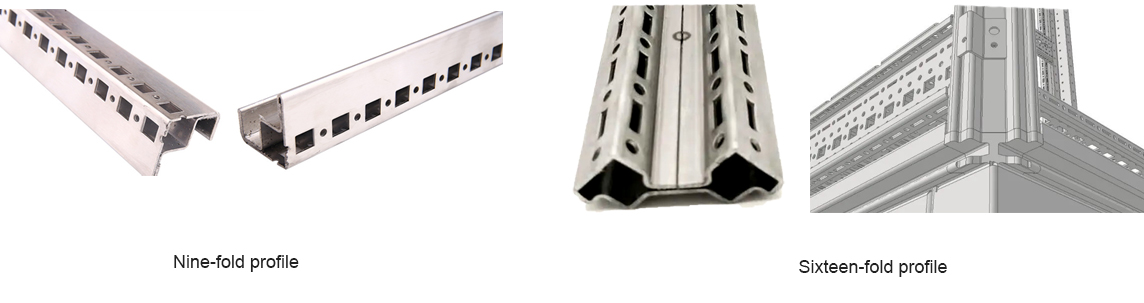
- Special Cabinet Profiles: Designed specifically for cabinet frames, these profiles feature pre-punched modular holes spaced at 25mm intervals. They’re lighter, stronger, and easier to assemble.
Special profiles include types like 9-fold and 16-fold profiles, which refer to the number of structural bends. A higher fold count increases strength and load-bearing capacity. For instance, 16-fold profiles—still under patent protection—can support up to 1000kg. Many Chinese manufacturers now use 15-fold variants to avoid patent issues while maintaining similar strength.
(2) Aluminum Profile Cabinets
Aluminum alloy cabinets offer an ideal solution for lightweight applications. Their sleek appearance, corrosion resistance, and ease of customization make them popular for general and light-duty equipment.
Key features include:
- Adjustable mounting columns for varying equipment depths.
- Smooth, screw-free exteriors for enhanced aesthetics.
- Surface treatments like electrostatic powder coating or conductive oxidation for grounding.
- Load capacity up to 1000kg with integrated heat dissipation and modular design.
3.2 Plate-Structured Electrical Cabinets
These electrical cabinets are made from a single bent steel sheet forming the door and side panels. The bends not only increase strength but also eliminate the need for additional beams or columns. With fewer components and better rigidity, they’re ideal for heavy or general equipment.
Although not as flexible as profile designs, plate cabinets remain a solid choice for applications requiring ruggedness and simplified structure.
Conclusion
Whether you’re choosing a electrical cabinet for a high-load industrial application or a lightweight modular control unit, understanding the different classifications by structure, connection, and material is essential. Each option presents trade-offs in terms of strength, flexibility, aesthetics, and cost.
At Anstorm Electronic Cabinet Co., Ltd., the company specializes in manufacturing a wide range of metal electrical enclosures tailored to meet your exact specifications—whether you require a high-strength welded structure or a modular aluminum solution.
Looking for the ideal electrical cabinet for your next project? Explore our product catalog or contact us for custom solutions.











