

Factory-built power systems are changing how data center projects plan and procure electrical equipment. On September 23, 2026, UL Solutions announced a certification pathway under UL 2140 for prefabricated power distribution assemblies. The program evaluates an integrated assembly, which may combine switchboards, UPS equipment, batteries and other connected equipment on a common skid. It does not mean that every individual metal cabinet or empty enclosure is UL 2140 certified. Read the UL Solutions announcement.
For a system builder, the enclosure remains a practical design decision. Its dimensions, access points, cable routes and mounting details need to fit the complete module. A good request for quotation starts with the system design and identifies exactly what the enclosure supplier will manufacture.
Updated October 8, 2026: this guide now reflects recent industry work on 800 VDC power distribution and direct-to-chip liquid cooling.
What changed in late 2026
Two developments are particularly relevant to data center equipment buyers. On September 25, UL Solutions described a new certification program based on UL 2877 for medium-voltage solid-state power units that support emerging 800 VDC data center architectures. The evaluation addresses the complete eligible power unit, including such areas as electrical protection, insulation, grounding, enclosures, interlocks, wiring and markings. See the UL Solutions overview of the UL 2877 program.
The Open Compute Project has also reported that Google, Microsoft and NVIDIA are working with the broader ecosystem to align common 800 VDC interfaces and system requirements. OCP describes both a near-term side-power-rack path and a longer-term direct medium-voltage AC to 800 VDC conversion path. This does not create one universal cabinet design. It increases the importance of defining the power architecture, interfaces, fault-protection boundaries and service clearances before the metal enclosure is released for production. Review the OCP 800 VDC update.
On September 29, UL Solutions separately launched a certification program under UL 4501 for eligible direct-to-chip liquid-cooling components and subassemblies. The program covers areas such as coolant compatibility, pressure and leak integrity, durability, flow and interoperability. For an enclosure RFQ, the practical lesson is to document liquid-line routes, service zones, drip or leak-management provisions, material compatibility and the physical separation required between cooling and electrical sections. Anstorm supplies fabricated metal enclosure bodies; cooling-system design and certification remain the responsibility of the relevant equipment and system providers. Read the UL 4501 announcement.
Add these items to an 800 VDC or liquid-cooling enclosure RFQ
- Architecture and responsibility boundary: identify the upstream and downstream equipment, nominal voltage, conversion stage and which supplier owns final system certification.
- Clearance and segregation: show the required electrical clearances, barriers, partitions and access zones on approved drawings.
- Interfaces: specify busway or cable entry, connector locations, grounding and bonding points, control wiring and reserved cutouts.
- Cooling boundary: mark coolant manifolds, hose paths, quick-disconnect access, drainage or leak-detection provisions and components that the enclosure supplier must not obstruct.
- Service and replacement: provide door swing, panel-removal paths, lifting points and the clearance needed to isolate or replace power and cooling modules.
- Verification documents: state the drawing approvals, material records, dimensional checks and project-specific inspection records required for the fabricated shell.
For projects that need a configurable cabinet platform, compare the PS modular steel electrical cabinet enclosure with a fully custom low-voltage distribution cabinet enclosure. Final construction should always follow the approved equipment layout and project requirements.
Start with the scope of supply
Define whether you need an empty cabinet body, a cabinet with a mounting plate, fabricated sheet-metal parts, or a fully populated electrical assembly from another supplier. Anstorm designs and manufactures metal enclosure shells and cabinet bodies. The system integrator determines component selection, electrical assembly and any required certification of the complete system.
Share a drawing or equipment layout early. Include the outside dimensions, material, sheet thickness, door arrangement, mounting details, lifting or transport features and required finish. State which openings the enclosure factory should make and which will be added later.
Plan access before finalizing the doors
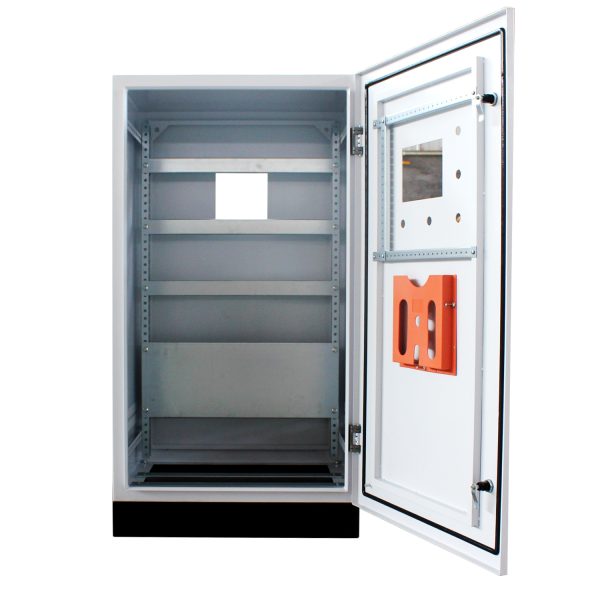
Power equipment needs room for installation, inspection and service. A single-door cabinet may suit a smaller control area. A double-door or modular layout can give technicians broader access to larger assemblies. Check the required door swing, clearance around adjacent modules, hinge location, lock arrangement and removable panels against the actual site layout.
The best configuration depends on the installed equipment. Do not select a door style from a product photo alone. Explore Anstorm’s metal enclosure range and send the equipment layout for a tailored review.
Coordinate cable entry, grounding and thermal design
Show cable-entry positions, gland plates, busbar interfaces and any reserved openings on the fabrication drawing. Identify parts that require bonding or grounding in the final design. If equipment generates heat, the system designer must specify the airflow or cooling approach before enclosure openings and seals are finalized.
These choices interact. An added cutout or ventilation opening can change the protection achieved by an assembled cabinet. A stated IP rating should be tied to the tested configuration and its installed components, not assumed to apply after site changes. The system builder should verify the final assembly against the project’s applicable requirements.
Select material and finish for the actual environment
Anstorm works with stainless steel, galvanized steel, aluminum and carbon steel. Material selection should reflect corrosion exposure, structural needs, fabrication details and the project’s finishing specification. For outdoor installations, define weather exposure, coating requirements, sealing details and any thermal management equipment separately. Ask the enclosure supplier to confirm the proposed construction against your drawings rather than assuming one material works for every site.
Keep enclosure claims separate from system certification
UL Solutions describes UL 2140 as a pathway for evaluating complete factory-built prefabricated power distribution assemblies and their interconnected components. Its announcement identifies specific Schneider Electric models as the first certified products. That certification should never be transferred by implication to an unrelated cabinet supplier, an empty enclosure or a different finished assembly. See UL Solutions’ explanation of the scope.
For a metal enclosure order, request the documents relevant to that exact enclosure and configuration. If your project needs complete-system certification, involve the responsible system manufacturer and certification body early.
Send a useful enclosure RFQ
To receive a practical quotation, provide:
- Overall dimensions and drawings, including tolerances and equipment layout.
- Material grade, sheet thickness, surface finish and operating environment.
- Door count, access clearances, locks, hinges and removable panels.
- Mounting plate, internal supports, cable entry and grounding provisions.
- Cooling interfaces, sealing details and any project-specific test requirements.
- Quantity, delivery location and whether you need a prototype before production.
Anstorm can review the metal shell requirements and identify fabrication questions before production. Contact us with your drawings to discuss a custom enclosure for your project.










