

The electrical cabinet is a fundamental part of any control system. Not only does it provide installation and support, but it also ensures electrical interconnection, mechanical transmission, safety interlocking, locking, protection, and even visual appeal. More importantly, it guarantees the compatibility between mechanical parts, electrical wiring, and components. In short, the cabinet serves as the “carrier” for all electrical elements.
1. Basic Structure of a Standard Cabinet
Standard cabinets are typically composed of four major systems: the basic frame, internal support system, wiring system, and ventilation system. Let’s explore each of them in detail.
Basic Frame
The basic frame is built using a modular approach. It includes a top cover, base, front and rear frames, doors, side panels, crossbeams, and angle brackets. This structure is designed to allow quick and secure assembly. Additionally, the front, rear, and side panels can be disassembled and reinstalled easily—making maintenance and customization more convenient.
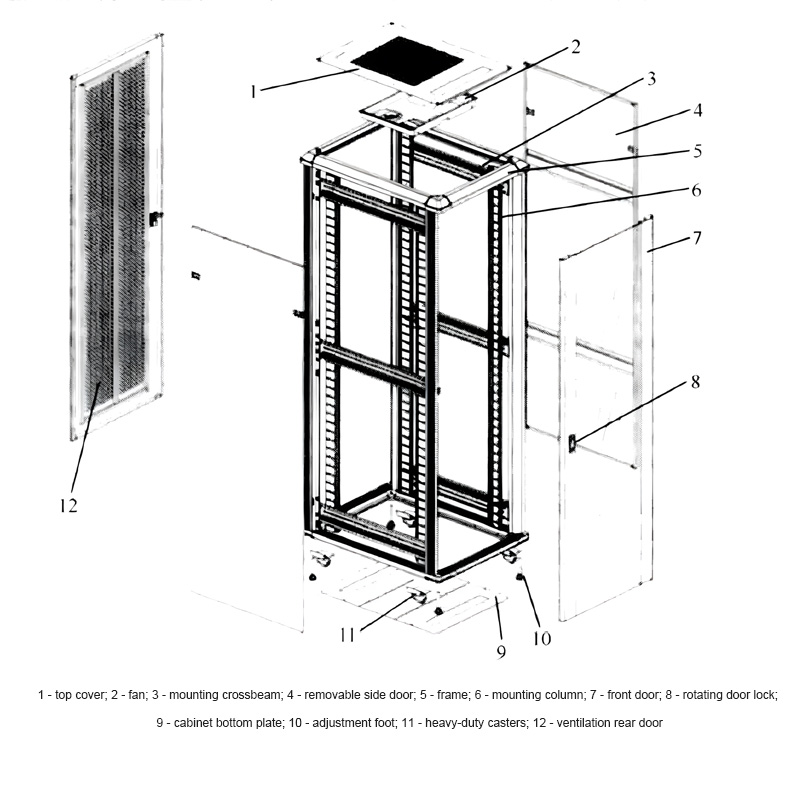
Internal Support System
To ensure the internal structure is robust and adaptable, several key components work together:
- Pillars
These vertical supports connect the top and bottom of the cabinet. Each pillar is pre-punched with mounting and alignment holes, making it easy to install both structural and electrical components. - Beams
Two main types are used. Hanging beams are movable and ideal for flexible installations, while extended beams expand the internal space and support wiring racks or distribution units. Both can be installed or removed effortlessly. - Trays
Fixed trays are used to hold equipment securely. They come in both standard 19″ and non-standard sizes, with depths such as 440mm, 480mm, 580mm, and 620mm. Standard trays hold up to 50kg, whereas reinforced models with added ribs support up to 100kg.
2. Wiring System
An efficient wiring system is critical for smooth operation. The following components are typically included:
- Power Cable Channel
This vertical duct runs from the bottom to the top of the cabinet. It powers internal equipment, such as fans, and is fully enclosed to reduce electromagnetic interference. - Cable Tie Plates
Two 100mm-wide iron plates are mounted vertically at the rear of the cabinet. Each features drilled holes to organize and secure cable bundles. A similar plate is installed on the opposite side for symmetry. - Wiring Trays
These can be mounted on the tie plates or directly onto the cabinet frame, allowing flexible cable routing. - Grounding System
A copper strip runs vertically through the cabinet’s center. Threaded holes are added every 2U to make it easier to ground numerous electrical components. The lower screw hole connects the system to an external ground wire. - Cable Entry and Exit Ports
A 300mm × 200mm port is cut at the rear base of the cabinet. Rubber lining protects cables from damage, while a raised panel above the port adds a finished look.
3. Ventilation System
To maintain stable temperatures and prevent overheating, various cooling strategies can be employed:
- Cabinet Cooler
These devices increase airflow, improve cooling efficiency, and help maintain ideal operating conditions inside the cabinet. - Variable-Speed Fan Unit
Installed at the top, this fan adjusts automatically based on ambient and internal temperatures. This not only controls heat but also helps reduce noise levels. Speed settings can be manually adjusted or infinitely variable. - Rack-Mount Fan Unit
With a slim 1U height, this unit can be positioned anywhere in a standard 19” rack to directly address localized heat sources. Its one-piece housing reduces vibration and extends the life of the fan.
4. Cabinet Accessories
In addition to the main components, a wide variety of accessories can be selected to meet specific project requirements. These include:
- Fixed or sliding guide rails
- Locking devices
- Cable chains and troughs
- Wire racks and comb-style cable organizers
- Specially designed fixed and sliding trays
- Power brackets
- Grounding rollers and lugs
- L-brackets, extension beams, and more
Together, these accessories ensure that the cabinet is not only functional but also adaptable for various electrical applications.
At Anstorm Electronic Cabinet Co., Ltd., the company specializes in designing and manufacturing reliable, high-quality metal cabinets. With over 15 years of experience and certifications including ISO9001, CE, and UL, we deliver solutions trusted by professionals across industries.
🔍 Explore more products: www.asdelectricalcabinets.com
📥 Download this article as PDF
🔗 Related Pages: Control Cabinets | Stainless Steel Enclosures | Custom Electrical Housings











